Go to the top of the List
| Vadamarachchi,Vadamaradchi,Vedamarachchi, Vatamaracci (Yapanaya [Jaffna]) VA`DDIMURAEKIYA hist. Baldaeus, 1658 has recorded name forms. Disc. The name in S. could mean Watch location (Murakiya → murachchiya) of the Vedda folk; or 'Vaedi' simply means "arrive = vadeema". This location controls access to the Vanni from the Yapanaya peninsula. It is a district subdivision and not a town by itself War: Army/navy camps, see Gatakaduwa (Kaddaikadu) and Weralakuruna (Vettlakerni) See Vadamarchchi debacle etc SL military medal Operation Liberation and Eealam war I | වැදි මුරැකිය |
Vadamarachchi (Mooladoova[Mullaitivu]) VAEDI-MURAKIYA N. B., this is not to be confused with the area in Jaffna Penn. with same name Ancient Buddhist ruins, Listed in 1982 by Archaeo. Dep. Somasiri Labeled #55 in Vanni Buddhist sites map | වැදි මුරැකිය |
| Vadaliyadaippu (Yapanaya [Jaffna]) VAEDILIYADDA n.b. a` as in at; V`adda or Veddha Disc. ' Vadali' in T. could mean 'young Palmayrah' However, it seems more meaningful to identify Vada to be from 'Vedda' consistent with the sinhala | වැදිලියද්ද |
| Vaddakandal (Madakalapuwa [Batticaloa]) VA`TAGANDARA kandal may also probably be attributed to a type of mangrove, botanical name Kandelia rheedii. or Rhizophora mucronata and Rhizophora candel. The word 'kandal' may also be atamilization of 'gandara', that is, the watery edge or swamp, where gan =river and 'dara' is related to 'addara'. 'The 'vaetta' indicates a demarcated area. | වැද්දකන්ද |
| Vaddakkachchi (Giranikke, [kilinochchi]) VADDAKACHCHIA Disc. In T. 'Vadakk-' could mean "notherly direction" But this does not give a complete meaning Regional map | වැද්දකච්චිය |
| Vaddumkaddu(Yapanaya[Jaffna]) VAEDAMANKADUVA Ancient Buddhist ruins, near Hunugama(Chunnakam). | වැදමන්කඩුව |
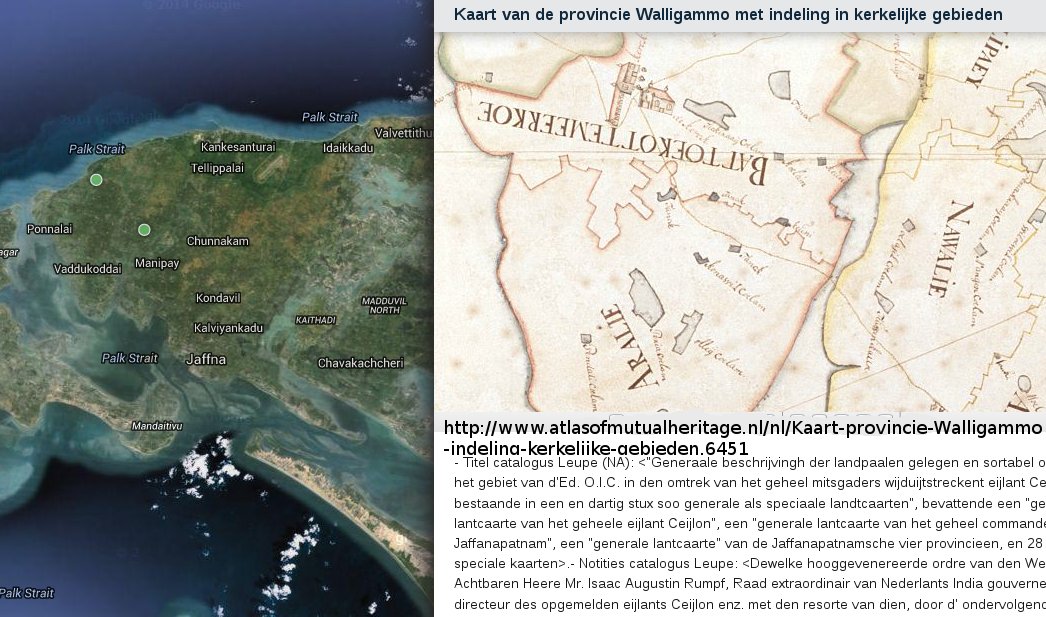
| Vaddukoddai, Vadukkoddai, Vaddukkodai, Vaddukkodai, Vaddukoddei, வட்டுக்கோட்டை (Yapanaya [Jaffna]) BATAKOTTE Disc. 'Batakotte' in S. means a fortified garrison of soldiers. Hist. Battecotte, Battoekotte Batecotte are spellings found in Dutch maps. 1719 Dutch map showing "Battakoette" ( Kaart van de provincie Walligammo met indeling in kerkelijke gebieden) Another old Dutch map, name given as Batekotta Source maps, Dutch period. Wone may wonder if Vaddukodai is vattukottei, meaning "circular fort". Vakra-kooti in Sanskrit can become Vakkotte in Sinhala or vattukottai in Tamil as a possibility. However, we reject this for clear reasons. When ever the Dutch found a place name or a proper name with a V they romanized it with a W. Thus we have Welligammo, or Warikkottur, etc., and proper names like Widyaratna rather than Vidyaratna which came during the British period. This is because the V in Dutch is an f sound. So, if the place name was Vakkotte, or Vattukkoddai, the Dutch maps should have been written as Waddukkotte and not with a B sound that even does not exist in tamil. Names romanized during the English period did not have this V --> W transfer. Thus in Jaffna, Tamil proper names were translated mainly during the time of the American missionaries, and so we have "Visvanathan" rather than "Wiswanathan". The older Colombo Tamils who got their names already during the Dutch period used the W rendering, as in Wigneswaran from Colombo. In the 19th century, the American Board of Commissioners for Foreign Missions (ABCFM) had founded a Seminary in 1823 and the place name "Batticotta" was used. The "Batticotte" seminary was closed in 1855 as the mission's objective of converting Hindus to Christianity was felt to have been unsuccessful. The Batakotte seminary is also mentioned by Emerson Tennent. The early period of American education has been covered by Dr. G. H. Piyaratna of the Vidyodaya University in "his doctoral thesis; American Education in Ceylon: 1810 to 1855" University of Michigan, USA. The first photograph taken in Ceylon in 1853, by Henry Martyn, is said to be that of a group of missionaries of the Seminary in front of the "Batticotte igreja" (church) built by the Portuguese in 1626. This church is now the Cathedral Church of the Jaffna Diocese of the Church of South India consecrated as such on October 10, 1947 See also, Ratnajeevan Hoole's discussion of What they are and How they Operate through Jaffna Central College and St. John’s College Histories . Jaffna college was found in 1870, where the Batacotte seminary originally stood. The episcopal control moved from the American Ceylon Mission (ACM) to the Jaffna Diocese of the Church of South India (JDCSI). The "Vaddukoddai resolution" (1976) of the TULF was proclaimed here, officially setting in motion the "two-nation" policy advocated by the Thamil Arasu Kadchi since 1949 (prior to the Vaddukoddai resolution, the Arasu Kadchchi sought a Federal constitution as a first step, at least in its English language manifesto. The Tamil publications of the "Arasu Kadchchi" were more separatist). Vaddukoddai was the constituency of the TULF leader Amirthalingam, murdered by the LTTE which regarded him as a politician who was ready to compromise the separatist ("Eealam") objective. Modern battles for the control of christian missions. TULF resolution in 1976 Rasalingam on the Two-Nation concept of the Arasu Kadchchi. Critique of Tamil Nationalism by Tamil intellectuals | බටකෝට්ටෙ |
| Vadduvakal, Wadduvakal (Mooladoova [Mullaitivu]) VATUVAGALA ⚓name the Indian Partridge, 'tittiri' in Skrt., and also in Pali. In addition, 'Kakkara' is used in Pali. A common name for the bird is "vatuva", or 'Us-vattuva'. This is located at the southern end of what was called the "No fire zone", the area used as the last stand of the LTTE in May 2009. The wreck of the Jordanian ship "Fara III" previously hijacked by the LTTE is located near here. Capturing the vatuvagala causeway LTTE hostages escaping | වටුවගල |
| Vairavapuliyankulama (Vavnimava[Vavniya]) VAYRAKOTIVAEVA Disc. In T., 'vairav' could mean "good" | වයිරකොටිවැව |
| Vakaneri, Vahaneri (Madakalapuwa [Batticaloa]) VAHANERIYA The name may have come from 'Pahaneriya', a jutting out bund(paha ←prakaara) Names like "Pakaneri, Nanguneri" are also found in Tamil Nadu [T. neriya.] Cut or broken piece;To arch, curve, bend (MTL page 2344); Sinhala 'neraa yaama' - to butt out, project, bend Also, nernci, neri-netti may mean "elephant-grass in T. There is a tank (vahaneri tank) here. The railroad passes through this area. Hist. Dagoba, structures, pond etc. Walter Rupasinghe's account Clashes between LTTE and Karuna | වහනේරිය |
| Vakarai, Vaharai (SiriGonakanda[Trincomalee]) [Batticaloa]) VIHARE, VAAKARÉ About 30 km north of Galthudava (Kalkuda) The name may mean 'Windy shore', or 'Vaakaré ' The tamil word, vikaram, விகாரம is given on p3635 of the Madras Tamil lexicon as Vikaram=Buddhist temple (vihara) , but forms derived from the stub 'vakara' do not seem to be listed in this or other tamil, Malm. or kannada dictionaries Tradition holds that a temple complex for monks and pilgrims to the area existed here. Hence an altrantive origin for the name may have been `Vihare'. War: Eelam IV Eastern front; LTTE/SLF/Karuna in Dec 2006 Army in Vihare' in Jan 2007 Map Map along the east coast. | වාකරේ, විහාරෙ |
| Valaichenai (Madakalapuwa [Batticaloa]) VALAS-HENA Paper factory. Disc. In tamil 'valai' could mean a 'net' Map | වලස්හේන |
| Valaippadu (Giranikke, [kilinochchi]) VALAPAATHA | වලපාත |
| Valaiyankaddu (Mannarama) VALAYAKKADUVA | වලයක්කඩුව |
| Valagnchiyan Veli, Valanchiyan Vaeli (Mooladoova [Mullaithivu]) PALAN-HETTI VAELLA Disc.-'Hetti, Chetty', or 'Cheyyar, hettiyar' are merchant groups referred to even in the Buddhist scriptures. Thus Anaathapindika was a "chetty" merchant. The place names Pollonaruwa, Pallonaruva etc., is sometimes said to contain references to Pulasthi, a mythical sage (earliest mention in the Rig Veda, III.53.16). Thus Palan-hetti are Chetty merchants associated with the city of Pulasthipura (Pollonnaruva). Associating Chetty merchants with various cities is quite common. The word 'Pallan' may also be 'Pollan', or 'Poron'. In that sense this mean "puraana-hetti", or simply "Aaadhi-hetti". For example, we also have the name 'Kasi-Chetty' which alludes to Chetty merchants from Benares (Kasi pura). 'Palan-hetti vaella' would thus be a 'sandy-field' associated with 'chetty' merchants from Pollon-nuvara (Pollonnaruva). It is common to find that the forms 'p','b', 'v' exchange, and 'palan ↔ valan' in many Dravidian languages. However,standard Tamil lexicons ascribe no clear meanings to the lexical forms or variants contained in this place name. | පලන් හෙටිටි වැල්ල |
| Valalai, Valalay, Valalaay (Yapanaya[Jaffna]) VAERALLA, DHOMATIYA, DHOMAETTA Disc. - Valalai ← Vazhalaay in Tamil may stand for a kind of clay ('Diyamaeti, Dhomaeti, Makulumaeti' in Sinhala) used in washing, and containing Bentonites and Montmorillite. It could be the origin of the place name, as in the case of the same place name found in Mannar. However, unlike in Mannar, there is no Montmorillite found here. This village is in the Vaeligama (Vallikamam) division of Jaffna, close to the Army. High security zone. Valalai has a Kaali temple. | වෙරුල්ල, දොහොමැටිය |
| Valalai, Valalayi, Valalaay (Mannarama [Mannar]) DHOMATIYA, DHOMAETTA The word 'Valalaai' in Tamil may refer to the Montmorillite and Bentonite clay (Fuller's earth, c.f., Valalai-Sutram in Sidhha-aurveda), found in this region. It is used in washing and clensing ('Dhomaeti') and may be the origin of the place name. The name 'Ottacci' is also used in Tamil for Fuller's earth. The Sittivinayagar temple, Neerpiddi murugan temple., and the St. Emilion church are found here. | දොහොමැටිය |
| Valithundal, Valiththundal (Yapanaya [Jaffna]) VAELITHUDUVA | වැලිතුඩාව |
| Vallaipadu, Valappadu (Giranikke [Killinochchi]) VAELLAPATUNA Map with A32-B69-A9 roads. Regional map | වැල්ලපටුන |
| Valliyapalli, Valliyappolai, Variyappalai (Mannarama) VAARIYAPOLA | වාරියපොල |
| Vallipunam (Mooladoova [Mulaitivu]) VAELIPUNNA, VELIPAENNA, Welipenna, Vaelibunna "Valli" may mean young girl, Murugan's consort, or a creeper, while poonam or punam may mean full moon in Tamil. This, the Tamil name makes little sense until it is interpreted as a Sinhala name. The sinhala name "welipenna" is quite common, but we do not know if this was a name used for this location. It has been suggested that this is possibly "Vaeli-bunna" from (සුන් බුන්) stones and sand. An arid, sandy, broken-up field. But theere is no evidence for it. "Welipenna" does not necessarily mean "sandy-waterwater hole", as it could also mean "Valli-punya", or Vaelipina, implying a shrine to Valli-amma or Goddess Pattini. This is a small place on the Paranthan (Puran thaenna)-Mulative (Moladoova) highway where the Tigers had torture prisons and Victor Base I. the notorious "Sencholai" suide-cadre training center said to be used for training young girls and into Suicide cadre. When the army dsetroyed it in August 2006, the Tigers claimed that this was an orphanage. The army claimed that it was a training center that they needed to justify. See more details under Sencholai' Victor Base 1, Vallipunam – LTTE”s secret prison & torture chamber for POWs & Tamils | වැලි පැන්න (වැලිබුන්න) |
| Vallikaman, Vellikamam (Yapanaya [Jaffna]) VAELIGAMA, Valukagama (in Chulawamsa) This is a district subdivision and not just a village Hist. 'Vaeligama' is mentioned in 'Sigiri Griffiti' -possibly 8th century CE. Dutch maps also indicate parts of the Jaffna peninsula as "Valikamam", and show that the name "Waeligama" වැලිගම held continuously till the time of the Sankilli era when the name was tamilized to Vaelikamam. See history | වැලිගම |
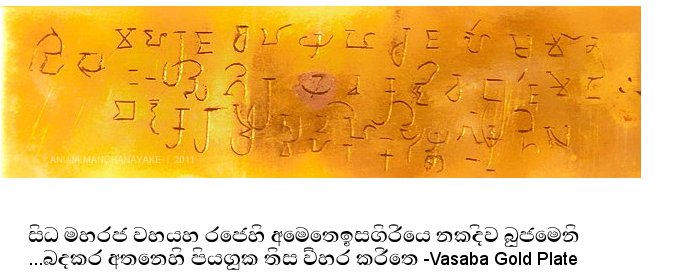
| Vallipuram (Yapanaya [Jaffna]) VAELIPURA, Bandakara-Aethana Disc. In cases where the original toponym was definitely `Vaeli (sand)', we have the tamilization 'Valli'. However,the possibility that 'Valli' may refer to 'Valliamman' and related Pattini cults etc., is less likely given the Buddhist history of this site, and earlier recorded name as 'Vaeligama'. There is also a "Singai Nagar" here. According to legend, it is believed to be "sinhapura", built by some of Vijaya's companions. (see C. Rasanayagam, History of Jaffna). Vasabha Gold plate (1st century CE), pre-christian Buddhist Temple complex probably dating back to the 2nd century BCE. The inscription has been translated by Paranavithana in 1936 as: "In the reign of the great King Vasabha, and when the Minister Isigiraya was governing Nagadipa (modern Jaffna peninsula), Piyaguka Thisa Vihara was built at Badakara Athana [S. Paranavitana, ``Vallipuram Gold-Plate Inscription of the Reign of Vasabha." Epigraphia Zeylanica, vol. 4 pp 229-236, (1936). The Vallipuram plate has been discussed in more recent works as well (c.f., Ven. E. Medhananda), and by tamil-nationalist historians who have looked for a different interpretation without much success. This inscription also supports the view that 'Nakadivu' (Naagadeepa) is the whole of the modern Jaffna peninsula. Map | වැලිපුර |
| Valukkiaru, Vallukkiaaru (Yapanaya {jaffna]) VAALUKA-AELA, VAALUKA-ARA 'Valukagama' is an ancient name mentioned in the Deepavamsa. This is an old water stream which has existed from ancient times, but interrupted by sandy patches ('valuka'), as it is mainly fed by water | වාලුකඇල, වාලුකආර. |
| Valvettithurai, Valvedditturai,Vellvettithurai, Velvettithurai(Yapanaya [Jaffna]) VAELIVAETITHARA Disc. 'Va`ti', or 'Va`di' in S. is from 'Va`deema', 'vadda', approach, c.f.., Pali "vattani" for path, road. 'Thara' is 'portal to the water', as in Sanskrit 'Theetha', Tamil 'thurai'. Thus the name means 'Sandy or scrub-land approach to the water' This is a Fisherman-Smuggler's village, mainly Catholic. When the Portuguese opened the sea lanes by controlling the Arab and other pirates, many ships passed through this region. Chetti traders from Tamil nadu built schooners similar to Portuguese ships and operated them using sailors from this area, and from Pt. Pedro (Peduru thuduva, Parithithurai) Valvettithurai sailors Westward Ho In 1942, April 7 leftist leaders Philip Gonawardana, NM Perera, Colvin R de Silva escaped to India in a 'Vallam" from VVT It is the birth-village of the LTTE leader 'V.Prabakaran' who eliminated and replaced the Colombo Tamil leadership. The LTTE developed fighters carrying cyanide pills, a sucide-bomb cadre, marine units, as well as child fighter brigades. Prabakaran and associates are wanted for the murder of Rajeev Gandhi, and murders of many Tamil, Muslim and Sinhala political leaders. He is hailed as fighting for "Eelam", an independent Tamil state, by many Tamils. P. Nadesan, LTTE polic chief, and political spokesman, is also from this town. Map | වැලිවැටිතර |
| Valvetty (Yapanaya [Jaffna]) VAELIVAETIYA | වැලිවැටිය |
| Vanathawilluwa (Puttalama) VANAATHAVILA | වනාතවිල |
| Vankalai (Mannarama [Mannar]) VAKKALA, VAKGALLA 'Vakkala' probably signifies a curved (sea?) passage among stones: Vakgalla → Vakkala → vankalai. Archaeological site (Carswell, John. 1991. "The Port of Mantai, Sri Lanka." ). The Vankalai sanctuary and Ramasar wetlands - the proposed area is bounded by Vankalai, Puliyantivu Island and Tiruketiswaram and includes the causeway between the mainland and the Mannar island. Ramasar wetlands and maps War: Home of Mary Qincy, LTTE suicide bomberr who attacked (17 Mar 1999) Chief Inspector Mohammed Nilabdeen, head of the anti-terrorism unit who survived the attack. The woman bomber jumped in front of a car carrying Chief Inspector Mohammed Nilabdeen of the Mount Lavinia police terrorist investigation unit, police said. Nilabdeen was wounded and hospitalized but doctors said he was out of danger. The attack took place when Nilabdeen was driving home from the Mount Lavinia police station after receiving a phone call saying that his wife was ill, police said. Beside the bomber, the dead included a man who swallowed a cyanide capsule when apprehended at the blast site, police said. Nilabdeen cracked the Chadrika assasination attempt However, under continued LTTE threat Nilabdeen left the country Birth place of Rev. Br. Baptist Croos, FSC | වක්කල |
| Vannankeni(Yapanaya[Jaffna]) VANNAKAENNA vanna-kaenna' is a dugout (well) used by the washer caste see Jaffna map1 | වන්නකැන්න |
| Vannankulam (Yapanaya [Jaffna]) VANNARAVAEVA, VANNANVEVA 'Vannan' probably refers to use by the washer caste. However, it is unusual to delegate a whole tank to a washer caste, unless it is a very minor tank. 'Vannara' refers to any type of monkey Map | වන්නරවැව, වන්නන්වැව |
| Vannarponnai (Yapanaya [Jaffna]) VANDURUPEANNA | වඳුරපැන්න, වානරපැන්න |
| Vannivilankulam (Mooladoova [Mullaitivu]) VANNI-VILA, Vannivil vaeva 'Vanni' in sinhala/prakrit means "forest". In Tamil 'vanni' refers to "clothes for washing", and "Vanniyar" is the corresponding caste. See Madras tamil Lexicon, p3565 for this another meanings which have no toponymic relevance. This place is located on the (Muvaavaeva)Mankulum-(Bellanvaeva)Vellankulam road Administrative Map, DS division Manthai East | වන්නිවිල වන්නිවිල්වැව |
| Vantharumoolai, Vantharamullai, Vandaramoolai,Vantharumoolai Colony (Madakalapuwa [Batticaloa]) VANDURUMULLA, BANDARAMULLA, BANDARAGAMA Sinhala names like `Bandaragama' etc. exist in the south. It is not clear if the name comes from the kandyan 'Biso-bandara' name or not, since this is an old site from the Ruhuna-kingdom times In reverting from tamilized forms, we need to respect history AND also remain close to current usage. Hence a compromise choice for the name would be BANDARAMULLA Map | වඳුරමුල්ල, බන්ඩාරමුල්ල |
| Vannathi Palam(SriGonakanda[Trincomalee]) SAMANALA AMUNA The 'Ceylon Steel Corporation' was a 'public benefactor' who repaired the Ancient temple here, in the late 60s. | සමනැලඅමුන |
| Varany (Yapanaya [Jaffna]) VALAANA, Varama | වලාන, වරාන |
| Vasavilan (Yapanaya [Jaffna]) VAASAVILA | වාසවිල |
| Varanai Iyattali(Yapanaya[Jaffna]) VARAN-YATTALA Disc.- Signifies a hamlet occupied by those 'who have been granted permission'. see Jaffna map1 | වරන් යට්ටල |
Varikottur, Warikkottur, Varikuttiuruwa, Varikuttiuruva (Vannimava [Vavniya]) VARIGANAM PURA, VARIKOTHTHOORUVA Disc.- 'Variganam pura' is an old town where tax levies were probably settled. In Tamil the 'ur' ending is a remnant of "(p)ur" for a town. 'vari' and 'Kottu' fit in with the above meaning. Ancient Buddhist site; in the list by Archaeo. Dep. Mr. Somasiri, 1982. Labeled #120 in Vanni Buddhist sites map | වරි ගනම් පුර වරිකොත් තූරැව |
| Vathiry (Yapanaya [Jaffna]) VAHIRA | වහිර |
| Vatharawathai, Vataravattai, Vatharawathal(jaffna[Yapanaya]) VAASALVATTA, KAEKURUVATHTHE Vathari (or more commonly Nari-Illanthai) in Tamil, is The Masan or Kaekuru Tree in Sinhala, Ziziphus jujuba. 'VAASALAVATTA' points the origin to the location of a 'stately mansion'. see Jaffna map1 | වාසලවත්ත, කැකුරුවත්ත |
| Vattappalai, Vattarappalai, Wattraipalai வற்றாப்பளை (Mooladoova [Mulaitivu]) YATRAPOLA, VATAVIHARE The name Vattapalli or round-temple (VATA-VIHARé) is associated with the Pattini (Kannaki) temple, built by Gajabahu I (114-136 CE) thus fusing Buddhist and Pattini worship. This is also a rest-point for a 'Paadayatra' (Paada=feet, yathra= means of locomotion) pilgrims going south, for example, to Katharagama, or going North, following the sacred places mentioned in the Buddhist text Nampotha. Rural resting spots for such pilgrims were known as `ambalams'. They existed all over the country. Images of `Ambalams' in the Meerigama area. The town known today as `Ambalangoda' in the southern coast had many such `ambalams' used for Paada-Yathra to Katharagama (Kathirkamam) via the southern route. "Pattini" as well as "Alexander" (Iskander → Skanda) are deified in Katharagama, within a non-Saivite (Murugan) devotional setting. Vattappali Amman Temple The alternative allonym may be related to 'paadayathra', or to the use of the location as a marina for boats. We may also note that 'vattapalai' is one of the ancient Tamil musical arrangements, although its relevance is probably minimal. The sinhala word 'vala' →'palai' in tamilization provides another possible etymology for this place name. Thus 'vaturavala' may suggest a source of water or a spring. It is today claimed to be an LTTE sea-Tiger base. | යාත්රපොල වටවිහාරෙ |
| Vavunakkulam (Mooladoova [Mullaitivu]) VANNIVAEVA 'Vanni' in sinhala/prakrit means "forest". In Tamil 'vanni' refers to "clothes for washing", and "Vanniyar" is the corresponding caste. See Madras Tamil Lexicon, p3565 for this another meanings which have no toponymic relevance. "Vavuna" does not exist in Tamil. The transformation of "vanni" to "vavni" is already noted in sinhala, with respect to Vavniyava. | වන්නිවැව |
| Vavnative, Vavunativu, Vavunathivu(Madakalapuwa (Batticaloa]) VANNIDOOVA, Vavniduva 'Vanni' in sinhala/prakrit means "forest". In Tamil 'vanni' refers to "clothes for washing", and "Vanniyar" is the corresponding caste. See Madras tamil Lexicon, p3565 for this andother meanings which have no toponymic relevance. "Vavuna" does not exist in Tamil. The transformation of "vanni" to "vavni" is alredy noted in sinhala, with respect to Vavniyava. | වන්නිදූව |
| Vavnikulam(Yapanaya[Jaffna]) VANNIVAEVA This in the Dunukaava (Tunukkai) DRO div. 'Vanni' in sinhala/prakrit means "forest". In Tamil 'vanni' refers to "clothes for washing", and "Vanniyar" is the corresponding caste. See Madras tamil Lexicon, p3565 for this andother meanings which have no toponymic relevance. "Vavuna" does not exist in Tamil. The transformation of "vanni" to "vavni" is already noted in sinhala, with respect to Vavniya. Ancient Buddhist site; A brick foundation, two pillars, alter moonstone, several ancient mounds, and a torso of a standing Buddha have been found. See also, Ven. E. Medhananda (Pachina passa-uttara passa 2003) | වන්නිවැව |
| Vavnikulam[Mooladoova[Mullaithivu]) VANNIVAEVA This is 11km S-W of Muvaveava(Mankulam), in the Tunnaka(Tunnakai) DRO division. It is the biggest Tank in the Mooladoova district. Jayapalan, a Tamil poet ('Kavithaigal - Perunthogai') has drawn attention to the caste struggle in the Vanni villages. Ancient Buddhist site; A brick foundation, two pillars, alter moonstone, several ancient mounds, and a torso of a standing Buddha have been found | වන්නිවැව |
| Vavuniya (Vavnimava [Vavniya]) VANNIMAVA Traditional entry to the Vanni , a word derived from the Sinhala vana = forest. Disc. The name 'Vavnimava →Vavnia' is sometimes interpreted as meaning 'end of tank construction', but it is more likely that the name is a modification of 'Vanni-nimava', i.e, the end of the Vanni. Thus 'Vannimava → Vavnimava →Vavniya' 'Vanni' in sinhala/prakrit means "forest". In Tamil 'vanni' refers to "clothes for washing", and "Vanniyar" is the corresponding caste. See Madras tamil Lexicon, p3565 for this and other meanings which have no toponymic relevance. "Vavuna" does not exist in Tamil. The transformation of "vanni" to "vavni" is already noted in sinhala. For Vanni caste, sociology etc. Manual of the Vanni J. P. Lewis. War Currently, the Army checkpoint to and from the Vanni, is at Omanda (Omanthai), just north of Vannimaava. See Youth gangs name after tamil films. Army map | වන්නිමාව |
Veddikkinaramalai, Vadukkamalai,Vedukinarmalai (mooladoova[Mullaitivu]) VAEDIKINNARA KANDA, vaddamana kanda Ancient Buddhist ruins, Listed in 1982 by Archaeo. Dept. Somasiri, 1982. This is near Ariyamauva and Naedunkurana. Sevearl abandoned tanks; the folk legends claim this to be an ancient domain (Vaddamana hill)of the Naaga people of early legends. There are remnants of two stupas on the hill. The stupas have been plundered by treasure hunters. Possibly some six or seven stone Sri Padas, remnants of buildings as well as many meditation caves seem to have existed. 2nd century BC Brahmi inscriptions are found in three caves. These inscriptions are discussed by Ven. E. Medhananda, p 376 (Pachcina passa-uttra passa, 2003). Vaedi 'Kinnara' is a low 'cast' Veddha group. Labeled #49 in Vanni Buddhist sites map | වැඩිකින්නරකන්ද |
| Veddukkadu(Yapanaya[Jaffna]) Vaevumkaduva Disc.- 'vaevumkaduva' is a piece of jungle land brought under cultivation; The sinhala name could be translated as 'vettu-k-kaatu' into Tamil, and may have become veddukaadu. Regional map see Jaffna map1 | වැවුම්කඩුව |
| Vedithaltivu, Vedithalteev, Vettithaltivu, Vidathaltivu (Mannaram [Mannar]) Andaradoova, This 'fishing village' was the main entry-point of LTTE weapons from the Mannaram coast, borugh in fishing trawlers from the Tamil-Nadu coast. The area was 'ethincally cleansed' of Muslim inhabitants in 1990 by the LTTE. see entry under Vidathaltivu | අන්දරදූව, විසගල්දූව |
| Vedivaithakallu (Vavnimava [Vavniya]) VAEDAVASGALLA, Vedawasgala rocky caves used for mediation existed here. | වැඩවස්ගල්ල |
Veherabaenda Vaeva(Vannimava[Vavniya]) Ancient Buddhist site Remnanats of a large stupa, said to be built by Viharamaha devi. Labeled #104 in Vanni Buddhist sites map | වෙහෙරබැන්දවැව |
| Velanai (Yapanaya [Jaffna]) BELLANA Disc.- 'Velan' in tamil connotes meanings related to the Velala caste, as well as to Skandha. However, this part of the ocean and shore were connected with Oyster fishery, and we consider that to be the origin of the "Bellana" name, where "bella" is generic sinhala word for Oysters, Clams etc. 'Muttu' or pearl fisheries were also part of the tradition here. Near Uruthota(Kayts), Perumkulam Muttumari Amman Kovil Civil war | බෙල්ලන |
| Velankulam (Vavnimava [Vavniya]) BELLANVEVA | බෙල්ලන්වැව |
| Velikkandai Giranikke, [kilinochchi]) VAELIKANDA | වැලිකන්ද |
| Velikkandal (Giranikke, [kilinochchi]) VAELIGANDARA This name may probably be attributed to a type of mangrove, botanical name Kandelia rheedii. or Rhizophora mucronata and Rhizophora candel. Botany The word 'kandal' may also be a tamilization of the sinhala 'gandara', that is, the watery edge or swamp, where gan(ga) =river and 'dara' is related to 'addara', neighbourhood. | වැලිකන්ද |
| Velikulam (Vavnimava [Vavniya]) VELIVEVA | වැලිවැව |
| Vellamanal (Sirigonakanda [Trincomalee]) VAELIVAELLA | වැලිවැල්ල |
| Vellamullivaikkal, Vellaimullivaikkal (Mooladoova [Mullaitivu]) VAELBATU-AGALA,Vael-batu-vakkkadé VAELBATUVAKKDE ⚓name Sign board Meaning: In S., Agala is a channal or sewer. Vakkadadaya is a water sewer or "Agala, (va)ggala, vakkala". In Tamil vaikkal could also mean a water sewer or drain. "Mulli" could also refer to "Batu"and "Vaelbatu" is a common species here. This is in the No Fire Zone in 2009 designated in 2009 during the LTTE last stand, Karaithuraipatru (Karathota-pattuva) AGA division, Mooladoova. Claims of civilian casulties in the NFZ report in the Island, 16-may-2009 Tiger protests in world capitals Velupillai Prabhakaran, the Leader of the LTTE was killed here in May 17 2009. See discussion under "Mulliyavalai" | වැල්බටුවක්කඩේ වැල්බටු අගල |
| Vellankulam (Mannarama [Mannar]) Ancient Buddhist ruins, see p78 E Medhanada(2003) BELLANVEVA | බෙල්ලන්වැව |
| Vellavely (Madakalapuwa [Batticaloa]) VA`LIVELLA | වැලිවැල්ල |
| Veloor (Sirigonakanda [Trincomalee]) VELGAMA n.b.: Sanskrit/pali "pura" → "(p)oor" → Dravidian/tamil: "oor"=village or city. | වෙල්ගම |
| Veerancholai (Madakalapuwa [Batticaloa]) VEERGOLLA 'Veera' is a tree, 'Drypetes sepiaria', found in the dry zone. | වීරගොල්ල |
Veerappanumaduva, Veerapanmadu(Mooladoova[Mullaitivu]) VEERA-PAENUM-MADUVA Ancient Buddhist site, listed by Archaeo. Dep. Somasiri, 1982 Labeled #81 in Vanni Buddhist sites map | වීරපැනුම් මඩුව |
| Venavil, Vaanavil (Mooladoova [Mullaithivu) THIRUVAANA VILA, VAANAVILA This is located close to Aluthkulissa (Puthukudiruppu) and believed to be part of the LTTE military establishment. 'Thiruvaana' is a quartz-like stone. | තිරුවානවිල |
| Vennappuva, Wennappuwa வென்னப்புவ(Puttalama) Vennapura, Wennappuwa. This place name is probably the one mentioned in the Chulavamsa and may have come from a name like wenpura, where 'vena', wena' is a caste that weaves baskets using reeds. Given the closeness of this village to Kalpitiya (Galpitiya) and the watery neighbourhood where reeds abound, this etymology may be reasonable. Today it has a significant catholic presence, and the family of Sardiel (19th century hero) has links with this town. | වෙන්නප්පුර |
| Veppankulam (Vannimava[Vavniya]) Kohombavaeva Disc.- Kohomba is Sinhala for 'Margosa' (Azadirachta indica) 'Veppan' is one of the many word-stubs in Dravidian (Tamil,Malayalam, K) referring to Margosa related trees, oils, leaves, bark etc. 4 km west of Vannimava(Vavniya), on the Mannarama road. LTTE-SL army, constant clashes | කොහොඹවැව |
| Veppanveli (Ampare) KOHOMBAVAELLA This is close to Thoppigala and has been an LTTE camp | කොහොඹවැල්ල |
| Vettilakerni Vettilaikerni (Yapanaya [Jaffna]) BEDILI-KAENNA, VEDILUNUKAENNA vettila in Tamil refers to Betel pepper. However, this is a beach head where no betel could possibly grow. The Sinhala name "Bedili-kaenna" implies a digging to partition the land. The sounds "V" and "B" interchange easily esp. in Dravidian etymology. That the name seems to imply a digging (Kaenna) for saltpeter (Vedilunu) used in gunpowder, has also been suggested to us but there is no supporting evidence. War: Army camp-Naval base east of Alimankada (Elephant Pass). The first battle for Alimankada, i.e., Operation Balavegaya , a massive amphibious operation under Kobbekaduwa was attempted via a sea borne landing at Vettilakerni (Bedilikaenna), located 12 kilometers east of Elephant Pass, scheduled for 14:30 hours on July 15, 1991. Once the beachhead was secured, Gen. Kobbekaduwa authorized Brig. Wimalaratne to link up with the garrison in Alimankada (Elephant Pass), about 10 km away. Sea piracy: in October 1994 LTTE destroyed the MV Ocean Trader off Vettilaikerni shores. | බෙදිලි කැන්න වෙඩි ලුනු කැන්න |
| Verugalai (Madakalapuwa [Batticaloa]) BERUGALA, VEHERAGALA There is also a Verugal Ara, which is simply the "aara" which flows by Verugalai. Beru is a type of tree as discussed in regard to the place-name Beruwala. Hence the name may have originate from trees growing between the rocky regions in this old Buddhist site. The more likely etymology is as follows: this old Buddhist site may have also been called "Veheragala", as stated by some traditions. However, there is at present inadequate source material to decide on the name. In Tamil, the word "Veru" வெரு may mean "poisonous drug",or "fear, dread", etc., and has no appropriate contextual meaning here. War: LTTE base till 2006, see links under the entry Somapura, sampur | වෙහෙරගල |
| Verugal (Sirigonakanda [Trincomalee]) VEHERAGALA, VIHARAGALKANDA (temple) New Hindu temple named Verugal Mohotturan Neela Amman Kovil build in 2002 See SL Parliamentary debates, Oct. 7 1983, distr. of Buddhist shrine Vihara Gal kanda | වෙහෙරගල |
| Vidatalpalai, Vidattalpalai,Wedithalpalai, Vidathtalpazhai (Yapanaya[Jaffna]) ANDARAVALA, VISAGALPALLA, VISADALPALLA See also Vidataltivu Andara, Dichrostachys cinerea , or Mimosa cinerea is a thorny shrub known as 'Vidaththal' in Tamil. This plant has over 70 tamil names and some 20 Sanskrit names (Bahuvaraka,..,Virtaru). The Tamil name 'Anantter' may be derived from the sinhala 'Andara' It could also refere to a centipede. 'palai' may also have evolved from the sinhala 'vala'. Map | අන්දරවල, විසගල්පල |
| Vidataltivu, Vidattaltivu, Wedithalthivu, Vedithaltivu விடத்தல்தீவு (Mannarama [Mannar]) ANDARADOOVA, VISADALDOOVA Disc.- 'Visa-dal' may refer to a kind of centipede, snake or a type of vegetation (plant). 'Andara', Mimosa cinerea, a thorny shrub, is known as 'Vidaththal' in tamil. The 'thorns' are the 'visadala' in Andara. This plant has over 70 tamil names and some 20 sanskrit names (Bahuvaraka,..,Virtaru). The tamil name 'Anantter' may be derived from the sinhala 'Andara' It could also refere to a centipede, since, in tamil, 'vitataali' may also mean a centipede as well. The tamil form விடுதலை .... could also be related to "liberation", "emancipation" etc., but this place name cannot be connect with such a meaning except by a big lexicological stretch. Fishing villages in the Mannaram coast close to and centered at Vedithalthivu (Andaradoova), were used by the LTTE for weapons import using fishing boats. Earlier, it contained a mixed population of Muslim and Tamil Catholic fisher people. Some upper-caste Land owning Tamils, and and a few Sinhalese traders existed here till the 1980s. The Muslim's were evicted by force in 1990 by the LTTE and many of those IDPs still live in the Puttalama area. The Muslim-Tamil conflict has once again raised its head, after the defeat of the LTTE, even while the previous displaced Muslims remain in Puttlama. The disputes arose in using the "Padawa" areas (a `paduwa' is a fisheries management zone where the fishing huts (wadiyas) are put up and the boats are moored. The word `Paduwa' probably arose form the sinhalese `paa-doova' or 'lower-islet'. For a full report see Mannar: The Inside Story July 28,2012 | අන්දරදූව, විසගල්දූව |
| Valaikattiravu(Madakalapuva[Batticaloa]) DAEL-PARITHTHA Disc.- The name in Sinhala means "net-spread", or a place used to spread fishing nets., In T. it means 'fishing nets used to catch fish'. | දැල්පරිත්ත |
| Vilattimoddai, Vilaaththimoadddai (Vannimava [Vavniya]) DIVULMOTTE, DIMBULMOTTE 'Divil, Dimbul' is woodapple (bot. Feronia limonia) in Sinhala. 'Motte' is a marshy, watery, shallow 'vila'. | දිවුල්මොටේ |
| Vilattikulam, Vilathikulam (Vannimava [Vavniya]) DIVULVAEVA 'Divul, Dimbul' is woodapple (bot. Feronia limonia) in Sinhala. | දිවුල්වැව |
Vilgamvehera, Vilgam Vehera, Velgam Vehera(Gokanna[Trincomalee]) VELGAMVEHERA is the ancient name, also called Periyakulam since 1929. Pali texts have also used the name 'Sarogaama' Vihara. Inscriptions, BathiyaTissa II(142-168 CE), suggest that the vihara developed during that time. However, much later, during the Chola period, Tamil Buddhists also paid homage to this temple. One Tamil inscription found here glorifies the victories of Rajendra Chola. Tamil Buddhists continued to use the old Sinhala name Velgam Vihara, as seen from the Tamil inscriptions. where the usage "Maanaavathie rate velgmvehera raja raja perum palli" is found. Maanavathie is the tank known today as "Periyakulam". The temple was also called "Rajarajaperumpalli" by the Cholas. Labeled #167 in Vanni Buddhist sites map Also see under 'Periyakulam' Some 4-5 km west of Velgamvehera, the site known "Buriyakulam kanda" contains remnants of a large Dagaba, stone pillars, rock caves, as well as pre-christian era Brahmi inscriptions. | විල්ගම් වෙහෙර |
| Vilankulam Periya-Vilankulam(SriGonakanda[Tricomalee]) MAHADIULVAEVA This is a part of the Moravaeva (Muthalikulam) colanization scheme, mostly developed in the 1980s. | මහදිවුල් වැව |
| Vilpanakulam, Wilpankulam(Sri Gonakanda [Trincomalee]) VILPANG VAEVA Disc.- 'Vilpang' is presumably 'Eleocharis Plantaginea' Ancient Buddhist site; in the list by Archaeo. Dept., Somasiri, 1982 | විල්පන්වැව |
| Vilpattu, Wilpattu (Anuradhapura and Puttalama) VILPATTUVA, VILPAETTTA Disc.- 'Vil' is the plural of 'Vila', i.e., 'natural lake' The tamil word 'Villu' is probably derived from the sinhala 'Vila', a point of view endorsed by Swami Gnanaprakasar. Thus it is not given in the Tamil lexicons or used in Tamil Nadu. The Tamil-lexicon meaning "bow" or "circle" is found for 'Vil". 'Pattuva' is most probably from the Pali 'Passa', 'direction', cf. 'Paeththa' Thus 'Vilpaetta' is the 'direction' where there are lakes. Note that 'Pattuva' is a subdivision of a 'Korale'. Vilpattu was designated a game sanctuary, 1905 (National park in 1938). The park is 425 Sq. miles, and 50km west of Anuradhapura. In ancient times the area contained historic hamlets, harbours etc. Legend has it that Kihirikanda(Kudiramalai), a point on the shore was the landing place of Vijaya, while Kuveni lived in 'Kālivila(Kali Villu)', in the Vilpattu. A place named Tammaenna vaetiya has been mentioned and associated with Kuveni (c.f., Kokila sandesha, 15th century), is inthe Puttalam district. Kihirikanda was visited by Roman sailors during the time of Claudius (417 AD), and Pliny talks of a large settlement here. There are stone pillars and other remnants of Buddhist ruins at Kālivila. More ruins are found near the Kokmotte bangalow; and near the Aelavuna Gala (Ochappu Kallu). A 2nd century BCE inscription is found here. Maradan Maduva, the present Vilpattu office area, is associated with Sāliya and Asokamāla, i.e., the time of Dutugamunu. 'Ransirimāle (tantirimalai) is also a part of the park since 1969, and is associated with the Saliya story (see entry under Tantirimalai) as well as Sangamitta's arrival with the Bo sapling. Ranpariththa (Pomparippu) is also in the Vilpattu region and is a part of the pre-history of the island (see entry under Pomparippu). There are ancient ports at Palangathota (Palangathurai) and Kollankanatte. There are some 30 lakes ('Vil', ot 'Villu') in the park, and their names are simple tamilizations, with the names usually ending in 'Villu'. Kumbukvila, Nelunvila, Kalaoya, are important 'villu'. "Kokmotte" or "Kokmote" is a popular Bangalow which has an "oya" (water stream: modaragam-aara) running near it. Manawila, Panikka Wila, Talawila, Maradamadu, Maenikapola uttu (Menikapola uttu) and Kala Villu are other well known bungalows. The place name "Maenikpola Uttu", has the word "Uttu" which is a Malayalam word meaning "feeding place". The park was closed in the eighties, and reopened briefly in 2003, but remained closed due to terrorist activity, landmines and other hazards, till 2010, after the Eelam wars. Remembering 1985 A'pura and Wilpattu massacre Wilpattu vandalized, March 2010 7nbsp; The Road Through Wilpattu= by Kiyaz Deen There are many small "tanks" (irrigation reservoirs) in the area. Maradamaduwa Tank, Ikiriyagollewa Tank, Mahawewa Tank, Andaragollewa Tank, Paarci-Baendi wewa, Moragllewa Tank, Palukola wewa, Walaswala Tank, Maenikaeththu Tank (Menikeththu =Menik Uttu) and Thela vaapi (Telveepu Tank). | විල්පත්තුව |
| Vimankamam, Vimankraamam(Yapanaya[Jaffna]) MINUVANGAMUVA Buddhist ruins, Viharaya etc. Mentioned in the 'Nampotha' a book listing Buddhist pilgrimage sites, dated in its 'modern' form to at least the fourteenth or fifteenth century. | ම්නුවන්ගමුව |
| Viralai (?) Viraela | x |
| Vinayagapuram (Ampare) VINAYAGAPURA | විනයාගපුර |
| Visvamadu, Vishvamadu (Mooladoova [Mullaitivu]) BISAVMADUVA In 2010 February the Police discovered a small scale factory which had once manufactured bombs in Vishvamadu. The police had acted on a tip off given by a member of the LTTE's former Charles Anthony Brigade. The is also a village/tank here known as "Visvamadukulam" (Viswamadukulam) That is BISOMADUVAEVA | බිසෝමඩුව |




No comments:
Post a Comment